|
|

Resources
There are many resources available for information about elder abuse, law and aging. We encourage you to visit some of these websites:
What is abuse?
NATIONAL
- Information from the National Center on Elder Abuse:
Federal definitions of elder abuse first appeared in the 1987 Amendments to the Older Americans Act, however, these definitions are guidelines. Each state defines elder abuse according to its unique statutes and regulations, and definitions vary from state to state. Researchers also use varying definitions to describe and study the problem.
Domestic elder abuse generally refers to any of the following types of mistreatment that are committed by someone with whom the elder has a special relationship (for example, a spouse, sibling, child, friend, or caregiver).
Institutional abuse generally refers to any of the following types of mistreatment occurring in residential facilities (such as a nursing home, assisted living facility, group home, board and care facility, foster home, etc.) and is usually perpetrated by someone with a legal or contractual obligation to provide some element of care or protection.
Elder abuse can affect people of all ethnic backgrounds and social status and can affect both men and women. The following types of abuse are commonly accepted as the major categories of elder mistreatment:
- Physical Abuse—Inflicting, or threatening to inflict, physical pain or injury on a vulnerable elder, or depriving them of a basic need.
- Emotional Abuse—Inflicting mental pain, anguish, or distress on an elder person through verbal or nonverbal acts.
- Sexual Abuse—Non-consensual sexual contact of any kind, coercing an elder to witness sexual behaviors.
- Exploitation—Illegal taking, misuse, or concealment of funds, property, or assets of a vulnerable elder.
- Neglect—Refusal or failure by those responsible to provide food, shelter, health care or protection for a vulnerable elder.
- Abandonment—The desertion of a vulnerable elder by anyone who has assumed the responsibility for care or custody of that person.
Although there are distinct types of abuse defined, it is not uncommon for an elder to experience more than one type of mistreatment at the same or different times. For example, a person financially exploiting an elder may also be neglecting to provide appropriate care, food, medication, etc. Visit Administration for Community Living for additional information.
- Elder Abuse Fact Sheet by Office of Justice Programs, U.S. Department of Justice
- Elder Abuse information from Ageing and Life-Course Section, World Health Organization
CALIFORNIA SPECIFIC INFORMATION
- What is Elder Abuse? (PDF) Elder Abuse Forensic Center
- California State Definitions (PDF)
- What Should I Know about Elder Abuse? by State Bar of California
Reporting Abuse
ANYWHERE IN THE UNITED STATES
- In case of emergency, call your local police station or 911.
- If you suspect elder abuse, neglect or exploitation, please call the national Eldercare Locator, a public service of the U.S. Administration on Aging at 1.800.677.1116. For a directory of reporting agencies by State, visit https://ncea.acl.gov/
- If You Know An Older Adult Who Is Being Harmed (National Coalition on Abuse in Later Life)
- If you suspect financial fraud, notify local law enforcement. You may also report fraud to state and federal authorities; get specific information at http://www.stopfraud.gov/report
CALIFORNIA
- Call the local police or sheriff's department or 911 if someone is at risk for immediate physical harm. If you suspect a crime was committed, contact the local police or sheriff's department.
- For abuse or neglect of a community-dwelling elder or vulnerable adult (not occurring in a licensed care facility), contact Adult Protective Services. http://www.cdss.ca.gov/inforesources/County-APS-Offices
- For abuse or neglect in a long-term care facility (e.g., nursing home, assisted living facility), contact Long-Term Care Ombudsman.
- Download the Reporting Form from California Department of Social Services
- For domestic violence services, call The National Domestic Violence Hotline 1-800-799-7233 or TTY 1-800-757-3224 or visit https://www.thehotline.org/
- To report consumer fraud to the CA Attorney General, visit http://oag.ca.gov/consumers
Help for Survivors
NATIONAL
- Help for Crime Victims (National Center for Crime Victims)
- Help for Survivors of Sexual Assault (Formarly CALCASA) (916) 446-2520
- National Domestic Violence Hotline Services 1-800-799-7233 or TTY 1-800-757-3224
- Ageless Alliance: United Against Elder Abuse grassroots elder justice movement
CALIFORNIA
- California Domestic Violence Hotlines and Services (California Partnership to End Domestic Violence)
- California Victim Services (California Victim Compensation and Government Claims Board)
- Consumer Resources from CANHR (California Advocates for Nursing Home Reform)
- Elder Abuse Problems and How to Ask the Court for Help (by California Courts Self-Help Center)
CONSUMER EDUCATION
- Red flags of abuse (PDF) in English, Spanish, Chinese, Korean, Tagalog and Vietnamese
- Protect Yourself From Abuse, Neglect and Exploitation! (PDF) in English, Spanish, Chinese, Korean, Tagalog and Vietnamese
- Eldercare Locator and National Center on Elder Abuse created a "Protect Your Pocketbook: Tips to Avoid Financial Exploitation" brochure for campaign to prevent financial abuse of older adults.
- "Home for the Holidays" What to look for during your annual visit to elderly relatives PDF by Mary Twomey, MSW. Print the "Home for the Holidays" flyer to hang up or hand out, and bring awareness to the signs of elder abuse.
- Elder abuse presentation by Dr. Laura Mosqueda (slides - PDF)
RAISING AWARENESS
- 12 Things that Anyone Can Do (PDF) Volunteer and awareness raising ideas
- Red flags of elder abuse bookmarks, front (PDF)
- Red flags of elder abuse bookmarks, back (PDF)
| Printable "Imagine A World Without Elder Abuse" Posters |
These files require Adobe Reader. |
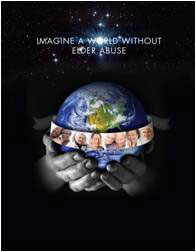 |
You are welcome to download these PDF files to print and distribute these posters.
These files require Adobe Reader. |
U.S. Government
- Administration for Community Living (ACL) on Elder Rights and Resources
- Administration on Aging Strategic Action Plan 2007-2012 (PDF) April 2007
- Clearinghouse on Abuse and Neglect of the Elderly (NCEA)
- Consumer Finance Protection Bureau
- National Long Term Care Ombudsman Resource Center (NORC)
- National Adult Protective Services Association (NAPSA)
- Advancing States (Formerly known as National Association of State Units on Aging (NASUA))
- National Center on Elder Abuse (NCEA)
- Office for Victims of Crime (OVC)
- Office on Violence Against Women (OVW)
National Associations and Advocacy Organizations
- American Bar Association Commission on Law and Aging
- AARP Policy and Research
- American Psychological Association: Office on Aging
- Elder Justice Coalition
- Hope Line for survivors of domestic violence and DV organizations
- Life Long Justice - Appleseed Initiative
- National Clearinghouse on Abuse in Later Life (NCALL)
- National Committee for the Prevention of Elder Abuse (NCPEA)
- Prevent Elder Abuse blog
- SafePlace
We've gathered tools and resources that we think would be helpful to many people in their work addressing elder abuse and neglect.
California Elder Justice Coalition News and Updates
California Innovative Long-Term Care Ombudsman Program Practices Webinar
Booklet of California Civil and Criminal Codes Related to Elder Financial Abuse
Report for Sonoma County's Elder and Dependent Adult MDT
368+ Elder and Dependent Adult Abuse Mobile App for CA Law Enforcement
Unlicensed Facility Fact Sheet and Screening Tool
Establishing an Elder Abuse & Neglect Screening Protocol in a Dental Teaching Clinic
Creating an Elder Abuse Forensic Center
California Elder Justice Coalition News and Updates
California Elder Justice Coalition (CEJC) works to protect the rights, independence, security, and well being of vulnerable older adults in California by improving the response of the legal, protective services and long term support systems. The CEJC News and Updates e-newsletter includes CA state and local news, national news, recently released research/reports, resources, and spotlights on promising practices. CEJC News and Updates: Dec. 2012-Jan. 2013
California Innovative Long-Term Care Ombudsman Program Practices Webinar
This free webinar highlighted:
- "Ombudsman and Long-Term Care Facilities - Preparing for Emergency Situations" by Karen Jones, Long-Term Care Ombudsman Services of San Luis Obispo County
- "Ombudsman Response to Unlicensed Residential Facilities" by Molly Davies, MSW, WISE & Healthy Aging Long-Term Care Ombudsman Program, Los Angeles County
View the recording: http://www.youtube.com/watch?v=dGqRTNC10PU&feature=youtu.be
Download the presentation slides (PDF)
Presented of Feb. 21, 2013 by the Center of Excellence on Elder Abuse & Neglect and made possible by a grant from the Archstone Foundation.
Booklet of California Civil and Criminal Codes Related to Elder Financial Abuse
This publication offers an overview of the law, issues and practical concerns of elder financial abuse from both a civil and criminal perspective.
Civil Elder Financial Abuse for Prosecutors/Criminal Elder Financial Abuse for Civil Lawyers (pdf) downloadable booklet was produced by Institute on Aging with material contributed by Helen Karr, Esq. and Steve Riess, Esq.
Report for Sonoma County's Elder and Dependent Adult MDT Incorporates County-wide Survey, Research on Regional MDTs, and Literature Review
A Collaborative Approach to Multidisciplinary Teams in Sonoma County
(pdf) by Adult and Aging Services Division, Human Services Dept., County of Sonoma CA (2012)
Sonoma County’s Elder and Dependent Adult MDT has been in existence in its current form for over ten years, and in that time many new collaborative ideas and practices have been developed. This report provides recommendations to improve the Sonoma County MDT, and thus improve services for our clients. Research for this report includes information gathered from current publications, observations of other California county MDTs, a survey of local Sonoma County agencies, and interviews with key informants.
368+ Elder and Dependent Adult Abuse Mobile App for CA Law Enforcement
The following California-based program highlights are from the Archstone Foundation Elder Abuse & Neglect Initiative, Phase II
Unlicensed Facility Fact Sheet and Screening Tool
by WISE and Healthy Aging Long-Term Care Ombudsman Program
Not only do residents in unlicensed facilities not have access to regulations that have been designed to preserve their rights in licensed facilities, they are also more susceptible to abuse and neglect. This fact sheet and screening tool allows for quick identification of unlicensed care facilities, and referral information to those agencies that handle complaints in these settings. The tool is designed for and has been distributed to many organizations and agencies including but not limited to: IHSS workers, APS, ombudsmen, fire fighters, police officers, building and safety staff, regional planning, regional centers, hospital social workers, and department of mental health patients’ rights advocates.
Initial Considerations and First Steps (MS Word): www.centeronelderabuse.org/docs/Unlicensed_Facility_Screening_WISE.doc
Unlicensed Facility Factsheet and Screening Tool (MS Word): www.centeronelderabuse.org/docs/Unlicensed_Facility_Factsheet.doc
Thank you to Molly Davies, MSW for permission to share these resources!
Senior Center Protection Plan
by the Fair Lending Project for Seniors
Fighting scams at senior centers takes a multidisciplinary team effort that is comprehensive instead of piecemeal. Our project develops a county-wide awareness campaign about financial exploitation occurring in senior centers and a step-by-step plan that cities can use to protect seniors from harm. A coalition of senior center directors, the District Attorney’s Office, local legal services agencies, city policy planners, private bar, senior advisory boards, and real estate and life insurance professionals works together to accomplish our goals.
Initial Considerations and First Steps (MS Word): www.centeronelderabuse.org/docs/ElderAbuseinHomeLendingProtection.doc
Sample Materials:
- Reverse Mortgage Letter (MS Word) www.centeronelderabuse.org/docs/Reverse_Mortgage_Letter.doc
- Predatory Home Mortgage Screening Tool (MS Word) www.centeronelderabuse.org/docs/Predatory_Home_Mortgage_screeningtool.doc
- Fair Lending Project Brochure (PDF) www.centeronelderabuse.org/docs/FairLendingProject_Brochure.pdf
Thank you to Shawna Reeves, MSW for permission to share these resources!
Establishing an Elder Abuse & Neglect Screening Protocol in a Dental Teaching Clinic
by University of California, Los Angeles, School of Dentistry
This UCLA School of Dentistry project focuses on developing a screening tool and reporting protocol for pre-doctoral dental students to use while working in the dental clinic. The screening tool, tailored for use in a dental teaching clinic, is also appropriate for use in private practice. Given that dentists are mandated reporters, there is a strong reason to adopt this screening tool and protocol in dental teaching clinics throughout California.
Initial Considerations and First Steps (MS Word): www.centeronelderabuse.org/docs/from _Classroom_to _Clinic_UCLA.doc
Sample Materials:
- Handout “Elder Abuse & Neglect Reporting Protocol introduced at the UCLA School of Dentistry Clinic” (PPT) www.centeronelderabuse.org/docs/EAN_Reporting_Dentistry_ Handout.ppt
- Screening and Reporting Overview (PDF) www.centeronelderabuse.org/docs/EAN_UCLA_Screening_and_Reporting_ Overview2.pdf
Thank you to Melanie Gironda, Ph.D. for permission to share these resources!
Creating an Elder Abuse Forensic Center
by University of California, Irvine, Center of Excellence on Elder Abuse and Neglect and the Orange County Elder Abuse Forensic Center
Typically, an elder abuse case requires weeks to months of phone calls among agencies with very distinct, and at times conflicting, perspectives and goals. Recognizing disconnections between the many disciplines that address elder abuse, the University of California, Irvine School of Medicine, Program in Geriatrics and agencies from social services and the criminal justice system piloted a groundbreaking approach to this problem: the nation’s first Elder Abuse Forensic Center (EAFC) in 2003. EAFC members meet regularly to determine concrete actions that can be taken on behalf of the client agency (e.g., Adult Protective Services, Long-Term-Care Ombudsman, Law Enforcement) to address the needs of a specific case. Members use their expertise and agency resources to provide direct help with the case.
Since the Orange County Elder Abuse Forensic Center was established, we have been approached by other communities interested in starting their own Elder Abuse Forensic Centers and assisted in the creation of two new EAFC's. Based on these experiences, we created a Manual and 20-minute companion DVD to describe how an Elder Abuse Forensic Center (EAFC) works and to help agencies develop a preliminary structure to create an EAFC in their own communities.
For more information, visit our Elder Abuse Forensic Center page http://www.centeronelderabuse.org/EAFC.asp
-
Directory of Regional Centers (Department of Developmental Services)
Multidisciplinary
- Elder Mistreatment (online book by National Academies Press) by Bonnie & Wallace, Eds, 2003
- The Availability and Utility of Interdisciplinary Data on Elder Abuse (NCEA)
- Another look at the helpfulness of occupational groups in the discovery of elder abuse and neglect (Abstract) Blakely and Dolon, Journal of Elder Abuse and Neglect 2001
- Elder Abuse Fatality Review Teams: A Replication Manual (pdf) ABA 2005
- Findings from an Elder Abuse Forensic Center. (Abstract) Wiglesworth, Mosqueda et al., The Gerontologist, 2005
- HIPAA Health Insurance Portability and Accountability Act of 1996
Although releasing medical information to APS is not a HIPAA violation, many medical providers are under the mistaken belief that it is. This letter was written by the federal government’s Office for Civil Rights in response to these concerns. It states that medical providers are required to release up-to-date medical information without an authorization or court order to Adult Protection Services.
To allow covered entities to appropriately share information in this context [of protecting individuals against abuse and neglect and domestic violence], and to harmonize the Privacy Rule with existing state and federal laws mandating uses and disclosures of protected health information, 45 CFR §512(a) permits covered entities to comply with laws requiring the use or disclosure of protected health information, provided the use or disclosure meets and is limited to the relevant requirements of such other laws. Where and to the extent that such disclosures are required by law, no authorization or court order is required for the disclosure.
Click here to download the PDF of this letter.
- A national look at elder abuse multidisciplinary teams, Teaster and Nerenberg, NCEA 2003
- Our Aging Population: Promoting Empowerment, Preventing Victimization, and Implementing Coordinated Interventions (PDF), 2000
- Forensic Markers of Elder Abuse presentation by Laura Mosqueda, M.D. (slides - PDF)
Law Enforcement
- 368+ Elder and Dependent Adult Abuse Guide for California Law Enforcement, a free smart phone/mobile web app by the Center of Excellence and the Institute on Aging in San Francisco
- National Institute of Justice: Elder Abuse
- Community Oriented Policing Services: Financial Crimes Against the Elderly
- Perceptions About the Criminalization of Elder Abuse among Police Chiefs and Ombudsmen. (abstract) Payne, Berg and Toussaint, Policing 2003
Legal
- ABA Commission on Law and Aging
- Legislative Update on State Adult Guardianship Legislation: Directions of Reform
- Life Long Justice - Appleseed Initiative
- Protecting America’s Senior Citizens: What Local Prosecutors Are Doing to Fight Elder Abuse, APRI 2003
- The Elder Law Journal, University of Illinois College of Law
- The Dynamics of Aging and Elder Abuse in the United States (PDF) Laura Mosqueda, MD
Judicial
- Effective Court Practice for Abused Elders (PDF) Judicial Council of California
- Center on Aging, Florida International University elder justice publications
- Judicial Responses to an Aging America (PDF)
- Adapting Trial Court Performance Standards to an Aging Society: Guardianship, Self-Service, and Criminal Cases Involving Elder Mistreatment and Domestic Violence
- Elder Abuse Resource Guide National Center for State Courts
Medical
- Elder abuse course created by Karran A. Phillips MD, of Johns Hopkins Internet Learning Center, can be accessed by visiting the website, www.hopkinsilc.org. Register as a new user for the Internal Medicine curriculum as a member of the Demonstration Group. Log on and complete the Elder Abuse module.
- Academy on Violence and Abuse (AVA)
- American College of Physicians’ PIER Guidelines on Reporting Elder Mistreatment (ACP membership required)
- Elder Abuse and Neglect course for physicians
- Kaiser Permanente Family Violence Prevention Program
- "Elder Abuse for Clinicians" Slide Lecture Presentation is designed for California-based physicians in training and health care providers seeking continuing education. Download “Elder Abuse for Clinicians” slides (PDF), Download “Elder Abuse for Clinicians” notes pages (PDF)
- "Medical Aspects of Neglect": A live satellite broadcast and webcast starring Dr. Laura Mosqueda that provides an in-depth look at elder abuse and neglect, focusing on the medical and evidentiary aspects of an abuse/neglect investigation.
- Suggested screening questions for elder mistreatment from the American Medical Association (AMA)
- “Reaching Important Gatekeepers: Training Pharmacists about Elder Abuse” (Center of Excellence, UCI Geriatrics, and USC School of Pharmacy)
- Dr. Laura Mosqueda partnered with QuantiaMD to create a 9-minute training video called, "Red Flags of Elder Abuse: Hx and Interview." A free membership is required to participate.
Social Services
- Building A Financial Abuse Case for the Criminal Justice System
© Candace J. Heisler, 2005 - Facing the Challenges of Dementia computer-based training, New York State Office of Children and Family Services
- National Clearinghouse on Abuse in Later Life, resources and publications
- NCEA Training Library for APS and Elder Abuse
- OVC HELP for Victim Service Providers Web Forum
Recruiting/Managing Volunteers
- Learning Points from National Conference on Volunteering and Service, 2007
Physical/Sexual Abuse
- Elder Abuse in the United States, National Institute of Justice, 2006
- The Clinical and Medical Forensics of Elder Abuse and Neglect Dyer, Connolly and McFeeley, 2003
- Lifecycle of Bruises in Older Adults, (abstract) Mosqueda, Burnight and Liao, Journal of the American Geriatrics Society, 2005
- Addressing Elder Sexual Abuse: Developing a Community Response, Pennsylvania Coalition Against Rape, Pennsylvania Department of Aging
Online Resources for Medical Images
- Health Education Access Library
- The Health Education Assets Library (HEAL) is a digital library of multimedia teaching resources for the health sciences. HEAL is a component of the National Sciences Digital Library.
- www.healcentral.org
- Medical Image Resource Guide
- UC Irvine
- Http://libguides.lib.uci.edu/medicalimages
- Medical Image Resources by Category
- Duke University
- http://guides.mclibrary.duke.edu/images
- Forensic Medical Examination Forms with Body/Face Diagrams
- California Emergency Management Agency
- https://www.ccfmtc.org/training-products/
Financial Abuse
- Bryan Kemp, Ph.D. Autonomy, Capacity and Undue Influence
- BITS Fraud Protection Toolkit (BITS Financial Services Roundtable 2010).
- Elder Financial Abuse: an Evaluation Framework and Supporting Evidence Kemp and Mosqueda, Journal of the American Geriatrics Society 2005
- Elder Financial Protection Network (EFPN)
- National Consumer Law Center publications for elders and their advocates
- U.S. Postal Inspection Service: Consumer Fraud and Mail Security
- Financial Fraud Enforcement Task Force, U.S. Department of Justice
Domestic Violence
- Domestic Abuse In Later Life (PDF), Brandl and Cook-Daniels
- Violence in Families: Assessing Prevention and Treatment Programs, Chalk and King,
- Wisconsin Coalition Against Domestic Violence
- Human Options: Safe Options for Seniors
Caregivers
- National Family Caregiver Support Program
- Family Caregiver Alliance
- Risk Factors for Potentially Harmful Informal Caregiver Behavior, (PDF) Beach, Schultz, et al.,
Journal of the American Geriatrics Society 2005
Neglect by Self or Others
- Consortium on Aging
- Could Self-Neglect in Older Adults Be a Geriatric Syndrome? Pavlou and Lachs, Journal of the American Geriatrics Society
- Neglect of Older Persons: An Introduction to Legal Issues Related to Caregiver Duty and Liability, American Bar Association, 2007
Hoarding
- Children of Hoarders
- Hoarding of Animals Consortium
- Hoarding: A Community Health Problem (PDF), Frost Steketee and Williams, 2001
Abuse in Institutions
- California Advocates for Nursing Home Reform
- Confronting Elder Mistreatment in Long-Term Care (PDF) Gibbs and Mosqueda, Annals of Long-Term Care, 2004
- Nursing Home Abuse Risk Prevention Profile and Checklist (PDF), National Center on Elder Abuse
For ideas and materials to help raise public awareness, visit our Public Awareness page.